
Introduction
A customer messages your business on WhatsApp at 11:40 pm asking about pricing. By the time someone on your team sees it in the next morning, it has already messaged two competitors and probably bought from whichever one replied first. This happens more often than most businesses realize, and it’s quietly costing sales every single day.
WhatsApp isn’t a side channel anymore for a lot of customers, it’s the first place they go before a form, before an email.
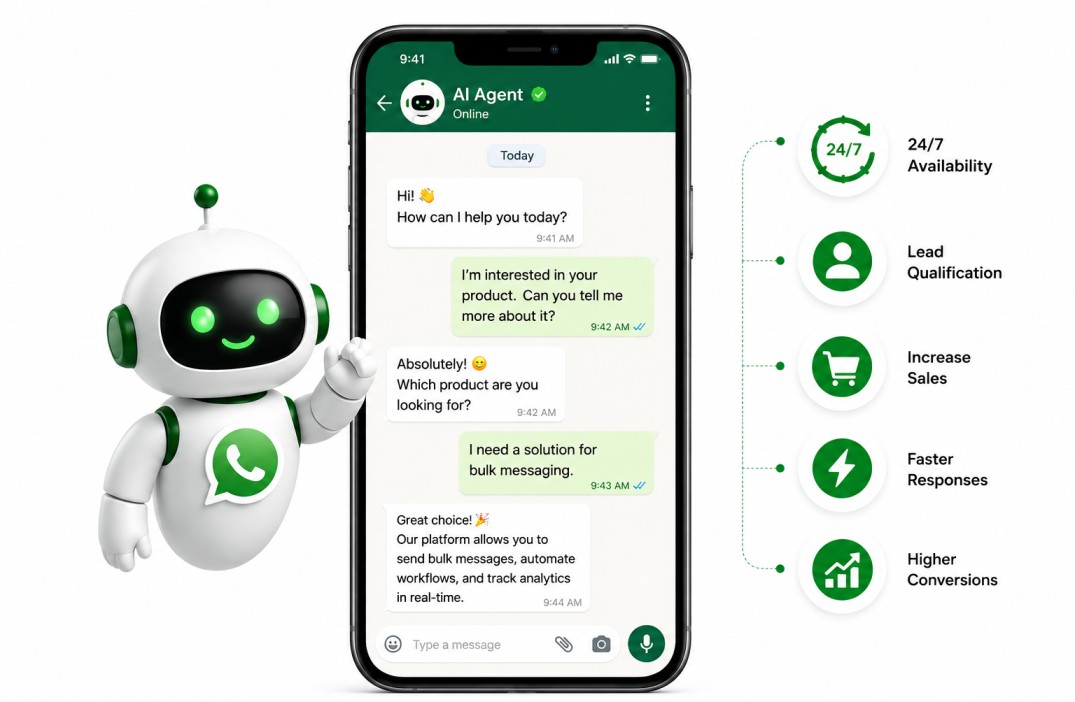
Sometimes before they even look at your website in detail. The problem is most businesses still treat it the way they treat email: check it when you get a chance, reply when you’re free. A WhatsApp AI Agent closes that gap. It’s not a scripted bot firing off “Thanks for your message, we’ll get back to you soon” — it actually understands what’s being asked and responds the way a well-trained rep would, using your own product info, pricing, and policies to do it.10 Reasons Why Businesses Using WhatsApp AI Agent
Here’s what that actually looks like in practice, and where it moves the needle on sales.
10 Reasons Why Businesses Using WhatsApp AI Agent:
1. Nobody waits
The single biggest lever in lead conversion is speed, and it isn’t close. A lead that gets a reply in the first few minutes converts at a wildly different rate than one that sits for an hour. An AI agent doesn’t get busy, doesn’t go to lunch, doesn’t clock out — the 11:40pm pricing question gets answered at 11:41pm, not the next morning.
2. It filters before your sales team has to
Not every “hi, interested” message is a real buyer. A good AI agent asks a few natural questions in the flow of conversation — what they’re looking for, rough budget, timeline — and by the time a human sees the chat, it’s already sorted into something worth a rep’s time or something that just needed an FAQ answer. Your team stops wasting mornings scrolling through inquiries that were never going to close.
3. It’s actually awake at 2am
This sounds obvious but it’s underrated. A meaningful chunk of browsing — especially in ecommerce and real estate — happens outside office hours. An agent trained on your knowledge base can answer the same question at 2am as it would at 2pm: pricing, shipping, what’s included in a plan, whether you deliver to a specific area. No “we’re currently offline” message losing the moment.
4. It remembers who it’s talking to
A customer who already asked about your Growth plan yesterday shouldn’t have to re-explain themselves today. Because the agent holds conversation context, it can pick up where things left off instead of starting from zero every time — which, frankly, is more than a lot of human support teams manage to do consistently.
5. It points people to the right thing, not everything
Say someone writes in: “I need something for customer support on WhatsApp.” A generic chatbot throws a menu of options back. A trained AI agent narrows it down — maybe it’s your shared team inbox, maybe it’s the AI agent product itself, maybe it’s a CRM integration — based on what they actually described. Fewer options, less decision fatigue, faster yes.
6. It chases the ones that went quiet
Somebody asks for a quote, seems interested, then disappears. Normally that’s just a lost lead sitting in someone’s inbox. An AI agent can follow up on its own — a gentle nudge two days later, a reminder about an unfinished signup, a “still thinking about the demo?” message — the kind of follow-up that should happen every time but rarely does when it’s left to a person’s memory and workload.
7. Booking a demo doesn’t need five extra messages
“Can we do a call?” “Sure, what time works?” “How about Thursday?” “Let me check and get back to you” — that back-and-forth kills momentum. When the agent can just show open slots and confirm a booking right there in the chat, the whole thing happens in under a minute, and the appointment actually gets on the calendar instead of drifting.
8. It knows when to get out of the way to Human Agents
This one matters more than people think. Automation is great until a conversation genuinely needs a human — a negotiation, a technical edge case, an annoyed customer. A well-built AI agent recognizes that moment and hands it off to a rep with the full history attached, so the customer isn’t stuck repeating themselves to a person who’s seeing the chat for the first time.
9. It keeps showing up without being annoying
Most leads don’t buy on message one. They’re comparing, checking with a colleague, waiting for budget approval. An AI agent can keep that relationship warm — sharing a relevant case study, answering a follow-up question, sending a useful update — so your business is still top of mind three weeks later instead of buried under forty other WhatsApp chats they forgot about.
10. It doesn’t buckle when things get busy
Run a sale, launch a campaign, get featured somewhere — and suddenly you’ve got 500 people messaging in a day instead of 20. A human team either drowns or the response quality drops. An AI agent handles that spike the same way it handles a quiet Tuesday, which means a good marketing push actually converts instead of turning into a backlog nobody gets to in time.
What actually makes one of these work well?
The agent is only as good as what you feed it. A few things worth getting right early:
- Keep the knowledge base current — pricing changes, product updates, policy tweaks all need to flow through, or the agent starts giving outdated answers.
- Set clear rules for when it should hand off to a human, rather than letting it try to close every conversation on its own.
- Check in on real conversations periodically. The first version is never perfect, and the gaps only show up once real customers start talking to it.
- Track it like you’d track a sales rep — response time, how many leads it’s qualifying, how many of those turn into actual bookings.
Why businesses land on Authkey for this?
Authkey’s WhatsApp AI Agent runs on the official WhatsApp Business API and trains directly on your own business material — PDFs, FAQs, SOPs, your website, whatever you’ve already got. It handles the qualification, the 24×7 answers, the appointment booking, and the handover to a human when a conversation actually needs one, all inside a shared team inbox so nothing falls through the cracks between AI and human replies.
It’s not meant to replace your sales team — it’s meant to stop them from spending half their day on conversations that never had a shot, so they can spend it on the ones that do.
Want to see it running on your own website? Start a free trial at authkey.io →